
Reply To: Coolant water loss
Traction Owner’s Club › Forums › 6 Cylinder › Technical › Coolant water loss › Reply To: Coolant water loss
 Philippe Allison
Hi Bob,
Below is a piece I wrote for our section “What’s going on in your garage?” You may find it useful!
Most of this Winter I have been working on and off trying to solve the cooling issues that most 6’s suffer from. They are fine all the time you are rolling along but when you get stuck in traffic in 30 degree heat it all goes wrong. One of the most annoying things is the “heat soak” when you turn the engine off. This happens even if you shut off at a normal engine temperature of 80 degrees, the retained heat in the block with no water circulating causes the temperature to rise rapidly often beyond boiling with the consequential water loss.
A number of modern cars use electric water pumps either as a booster pump or as the primary pump, the advantage is they can operate independently of the engine rpm. With a mechanical pump and fan they are working their hardest when you need them the least, rolling along at 50mph. They are at their slowest and least efficient when you are stuck in traffic. The solution is an electric water pump and electric fan.
I have chosen the Davies Craig water pump and electronic controller and a Comex high power fan. I am hoping that I will be able to run with no mechanical fan. The Big 6 fan is a huge cast aluminium lump that must take a significant amount of horsepower to drive it, it is also noisy!
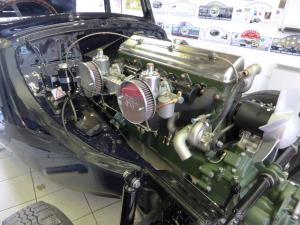
You will also notice from this picture the arrangement of the water pump; it is driven by the cam shaft and sits externally on the side of the engine. The new Davies Craig pump is of a similar size. I have used the existing mountings on the engine and with the new bracket I made it fits nicely on the side of the engine.


The Davies Craig System complete with the electronic controller is a “Plug and Play” system, it comes with it’s own wiring loom and just needs a few electrical connections, much like fitting a car radio.
With the new radiator fitted and the system filled with coolant I was ready to test it.

With an EWP® & Fan Digital Controller (12 & 24V) (PATENTS: USA 6425353, EU 1133624, AUS 756453), the speed of the pump is managed by the controller which varies the supply voltage to the pump and so varies the speed of the pump up or down hunting for a target temperature. When the engine reaches the target temperature, the controller locks on whilst constantly changing the Electric Water Pump speed to account for traffic and throttle conditions whilst all the while maintaining the target temperature independent of the engine speed. When the EWP® struggles to maintain your target temperature, the Digital Controller will operate the engine’s electric fan automatically once the engine has reached +3°C (+5.4°F) above the targeted / set temperature. Another significant benefit is that the Controller allows the EWP® & Fans to run on after ignition shutdown for either 3 minutes or -10°C (-14°F) of set / target temperature to eliminate heat soak.
Due to “lockdown” and the lack of an alternator my only testing has been confined to the workshop with the car stationary, so far the results are exactly what was claimed in the sales literature and what I was expecting. The ambient temperature in my workshop has been as high as 25 degrees during my tests.
To summarise:
1. The engine reaches its optimum operating temperature of 85 degrees very quickly.
2. That temperature is maintained without excessive use of the electric fan.
3. When the fan does run it is for a very short period of time as the pump is circulating the coolant more efficiently.
4. I have turned the engine off just as the electric fan starts and the fan and pump “run on” very quickly lowering the temperature. When the system shuts down close observation of the temperature gauge shows no signs of any “heat soak”
5. Finally, without the mechanical fan the engine is quieter and I am hoping to see a benefit in engine power and a reduction in fuel consumption.
All that remains now is for the alternator to be returned and fitted and a full road test undertaken, that will be for another day.
I have now had the car out on the two hottest days this year and it has behaved faultlessly.
I hope this helps Bob!
Best wishes Philippe