
jerky drive
Traction Owner’s Club › Forums › 6 Cylinder › Technical › jerky drive
Tagged: Diff problem. Jerky drive.
- This topic has 16 replies, 5 voices, and was last updated 3 years, 1 month ago by Bob Cross.
-
AuthorPosts
-
25th June 2023 at 12:32 pm #33669
Bob Cross
ParticipantI have a 1949 RHD Slough Built Big Six
There is excessive play in the transmission which results in a jerky ride when coasting along between accelerating and overrun . The play is 60mm on a front wheel measured at the tyre tread, when one wheel is on the ground and the other jacked up. The raised wheel can be turned, by hand, 60mm between stops. I’ve checked the drive shafts – these are recently new (without Bibax) from Franssen. The gearbox flanges are all tightly bolted, so I think the problem must be inside the gearbox itself (?)
Any thoughts please
Thank you
Bob Cross
25th June 2023 at 3:34 pm #33671Bernie
ParticipantBob,
If all external drivetrain components are apparently free from excessive play, it would lead me to suspect excessive diff. backlash, either in the planets or between crownwheel and pinion.
On a different note, I would be interested to know how you think your non-Bibax shafts compare with the originals … can they be fitted without having to dismantle the swivels?
B…
26th June 2023 at 2:41 pm #33673ParticipantHi Bernie
Thank you for your prompt reply to my post. I had suspected that the next stage is to open up the gearbox and see what is revealed. By the way, do you know what would be the
‘normal’ play would be at the tyre as I have described? About the Bibax shafts:-
I don’t know about the comparison between Bibax-fitted and non-Bibax fitted shafts . I had assumed that the advantage of Bibax shafts would have only been apparent at the the extreme end of the performance range -hard cornering and acceleration , braking, rough terrain. I drive quite sedately so I have noticed no difference.
When we fitted the new non-Bibax shafts, initially we had hoped to slide them in without dismantling the swivels, but in the end we did have to take apart the top swivel and with difficulty got the shaft fitted.
Bob
27th June 2023 at 8:45 pm #33677ParticipantBob,
I shall measure my “play” tomorrow and revert but, in the meantime, I have had another thought about the jerky ride. I recently drove a friend’s Légère which was acting much as you describe, creating a very uncomfortable ride. It transpired that the timing had shifted and was much too far advanced. After 2 days of slipping the clutch and keeping the revs high in an effort to reduce the lurching, normality was achieved by simply retarding the timing – quite a lot. Might just be worth checking that out?
Bibax – My understanding is that, in view of the high torque generated by the 6 engine, the Bibax was incorporated to minimse shock to the clutch and gearbox particularly when pulling away from a standstill. It would therefore seem less important when driving normally.
Thanks for confirming that, like the 4 cylinder models, the non-Bibax shafts are not just a simple fit.
B…..
- This reply was modified 3 years, 1 month ago by Bernie.
28th June 2023 at 12:59 pm #33681ParticipantBob,
Are you sitting comfortably ?……..
I have just checked the backlash/play on my 15/6. With the car in 3rd gear and the right wheel on the ground, the left wheel can be rotated per the markings in this picture…
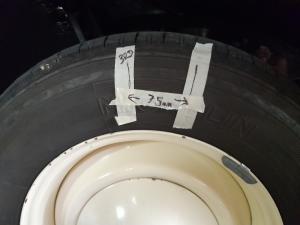
The 75mm is measured at the point at which it is marked, roughly in the middle of the tyrewall. Displacement at the tread is therefore nearer 100mm – apparently much more than yours. Despite that I definitely do not have anything but a smooth, comfortable ride in all gears at all speeds.
Out of curiosity, I also repeated the exercise with 1st gear engaged. That gave a very similar, possibly slightly lower result. I think the small difference could perhaps be attributed to the crude checking system but is probably different gear wear.
My findings lead me to believe your problem is unlikely to be caused by the play in your transmission.
Hope this helps.
B….
28th June 2023 at 1:33 pm #33683ParticipantHi Bernie,
Thank you so much! Amazing if the gearbox is OK. I’ve had visions of digging deep into my pocket for repairs or saying goodbye to the car altogether!
I’m going to have a lie down now and when I have recovered, repeat your experiment on my own car!
I’ll keep you informed
Regards
Bob
1st July 2023 at 7:03 am #33695Dave Thornley
ParticipantGot me thinking now I might go and have a measure too.
2nd July 2023 at 9:40 am #33697ParticipantHi Dave
It would be really interesting if you could do the measurement on your car and post the result. Are you getting any ‘jerking’?
Regards
Bob
2nd July 2023 at 10:00 pm #33701Chris
ParticipantBibax is a new term to me, not knowing much about these 6 cylinder cars. So I googled a bit and on the Yellow Box Engineering website https://www.yellowboxengineering.co.uk/store/Traditional-Driveshaft-for-Citroёn-15-6-&-15-6H-p154980761 it says of their non-Bibax driveshafts:
<p style=”text-align: center;”>”Only to be used with a sprung friction disc, alternatively use the Bibax driveshafts!”</p>
What is this “sprung friction disc” of which they speak?. Where does it fit? And, Bob – does your car have it?3rd July 2023 at 10:36 am #33703ParticipantChris,
The Bibax is a shock-absorbing section of the driveshaft. It has a female splined core which accepts the gearbox output shaft. The core is bonded, via a polymer, to the outer shell. That then bolts to the outer (wheel) end of the driveshaft. It is perhaps best likened to an in-line silentbloc.
The “friction disc” is the clutch plate. Early versions were solid with the splined centre riveted directly to the steel disc carrying g the friction rings. Modern plates incorporate springs between the centre and the disc to absorb any sharp impact should the clutch be engaged too fiercely. The Bibax is therefore less critical if the disc is sprung.
B…….
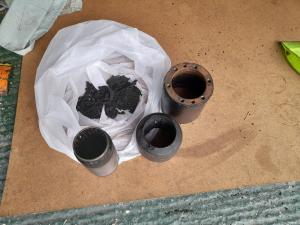
3rd July 2023 at 10:51 am #33705ParticipantMy problem in France last summer was a failed Bibax. The bond had sheared allowing the inner to slip within the outer when the weight was on the ground. However, there was enough friction remaining in the system to prevent the wheel being turned manually when it was jacked up so it took a while to realise the problem.
My failed Bibax ….
Replacement (borrowed) Bibax …
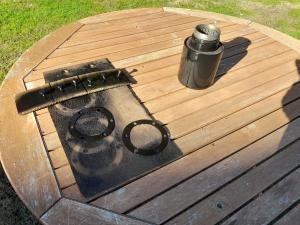
B…..
3rd July 2023 at 12:30 pm #33707ParticipantHi Chris,
Bernie has given an excellent description of Bibax and the sprung friction disc. At the moment, though I know I have a twin-plate clutch, I don’t know if the plates are ‘Sprung’ My next move is to try Bernie’s suggestion of looking at the ignition timing. With luck that may be all that is needed to fix the problem. Otherwise I will have to have the gearbox opened and examined – expensive!!
Bob
5th July 2023 at 2:21 pm #33733ParticipantHi Bernie,
Thanks to your advice I’ve discovered that problem was not in the gearbox (thank goodness) but in the carburettor adjustment. I enriched the mixture, increased the tickover, and then ran the car on the M5 and M42. Problem solved! The engine must have been cutting out on the overrun. Your observations – measuring the play on the tyre wall – experience with your friend’s ignition – helped me to “think outside the box”(sorry!). I’m very grateful. If we ever meet you will find many drinks behind the bar with your name on them.
Regards
Bob
6th July 2023 at 9:30 am #33735ParticipantBob,
Glad to know you are sorted – and at minimal expense.
I shall, of course, be overjoyed to help you spend some, if not all, of the pennies you have saved when a suitable opportunity presents itself.
Meanwhile, happy motoring.
B…..
8th July 2023 at 10:37 pm #33749Participanta
A happy ending – Bob’s car works, I’ve learnt something and Bernie is a few drinks in credit. Very satisfactory. Thanks Bernie and Bob.
Chris
-
AuthorPosts
- You must be logged in to reply to this topic.