
Head Gasket shape
Traction Owner’s Club › Forums › Technical › Engine › Head Gasket shape
- This topic has 5 replies, 4 voices, and was last updated 1 week, 3 days ago by André.
-
AuthorPosts
-
21st April 2026 at 10:31 am #38067
Alex Farr
ParticipantHi all,
My 11BL is currently in the garage having its engine rebuilt. I was sent an image that gave me pause, and I was hoping someone here might be able to help.
The cylinder holes in the head gasket are not perfectly round, they appear to be pear-shaped. This struck me as odd. I’ve now bought two head gaskets and both are the same, and a quick look at images online confirms it’s consistent across the board, so I’m ruling out a manufacturing defect. But it does still seem strange.
My question is: why are the cylinder holes pear-shaped rather than round? And would the resulting irregular space within the combustion chamber risk creating a hot spot or cause any other issues?
I’ve attached the photo below — take a look and let me know your thoughts!
p.s. this car is now to me, and i am still learning about tractions so any information welcomed.
- This topic was modified 6 months, 3 weeks ago by Alex Farr.
Attachments:
You must be logged in to view attached files.23rd April 2026 at 9:39 am #38083Chris
Participant<p style=”text-align: left;”>Hi Alex</p>
I went back through the photos and the gasket I removed from my engine was just like that. That was built in the ‘80s.i don’t know but I suspect the reason is to accommodate positioning errors which would likely be greater along the axis of the engine block than across it.
anyway – nothing to worry about.
Chris
6th May 2026 at 4:54 pm #38129Bernie
ParticipantHaving spent my working life in gaskets – much of it with the company that made the original parts for Citroën – and having fitted dozens of these myself, I confess I had been aware of – but never considered – this apparent anomaly. Alex’s question therefore compelled me to investigate further.
First of all, I can confirm the unusual gasket bore shape is correct. Here is a shot from a period catalogue which shows that, unlike others on this page, the bores of both 40.000 and 40.531 are not circular.
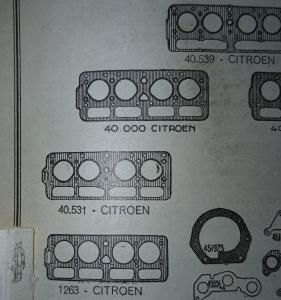
40.531 is the original “Perfo” CHG and 40.000 was for a RWD saloon with a similar bore and stroke.
I can also confirm that the CHG for the 6-cylinder engine also has the same, non-circular, bore shape.
The critical sealing area is where the gasket sits on the top surface of the liner. Chris’s suspicion is interesting but longitudinal movement in any one direction would amplify the possible offset at the other end so I doubt that is the likely reason. Nevertheless, I cannot think why this bore shape was considered necessary.
As the enlargements are on the exhaust valve side of the bores, I wonder if it could be to minimise the chance of gasket damage from the exiting exhaust gases?
There has to be a very good reason for this because the cost of tooling for an iregularly shaped hole will clearly have been considerably higher than for a round one.
If somebody else can throw more light on this, I should love to be educated.
B….
14th May 2026 at 1:15 pm #38165ParticipantThanks for the replies.
It has been interesting reading your comments. The engine is now back together and workig lovely so fingers crossed.
It was interesting to note that the gasket that was taken off does not seem to have this teir drop shape, but then it also looks more like a H van head (attached).Attachments:
You must be logged in to view attached files.14th May 2026 at 3:50 pm #38175ParticipantGlad to know you are back up and running.
B….
29th October 2026 at 1:02 pm #38992André
ParticipantThe tear drop shape of the head gasket is to match the shape of the top of the cylinder head , which is tear shaped on the exhaust valve side. The cylinders in the block are round.. If a round hole gasket is fitted the tear drop side will not be fully held down by the head, it will disrupt the exhaust gases going out also it would eventually burn away. I’ve recently have an issue with a head gasket set. 1950 4 cylinder Prefro engine. I got a complete gasket set from Citroen Classics and discovered that the head gasket is for an H van ( round holes ) not a traction. Seem that the manufacturer/ supplier has packed the wrong gasket in the traction gasket sets. Awaiting a replacement. So If you’ve ordered or received a gasket set . Best to check it out
-
AuthorPosts
- You must be logged in to reply to this topic.