
Coolant water loss
Traction Owner’s Club › Forums › 6 Cylinder › Technical › Coolant water loss
- This topic has 11 replies, 4 voices, and was last updated 5 years, 3 months ago by Bob Cross.
-
AuthorPosts
-
25th July 2020 at 12:03 pm #27082
Bob Cross
ParticipantI have a 1949 R.H.D Slough built Big Six. During the last week I have driven over 300 miles in it. Motorway (60-70mph) and country roads 50-60mph. The water temperature gauge shows 80-90 degrees C. Everything goes well until occasionally, suddenly the water temperature gauge needle flips over to 110+ degrees. Fortunately I have been able to stop, see that the water has mostly disappeared from the header tank, top up with over 1-2 pints+ of water and proceed on my way? Everything is then OK for many miles.Any ideas about the loss of water?Its not leaking from the hoses or from the cylinder head as far as I can see. No steam from the exhaust as far as I can see. The radiator cap is not a particularly good fit, maybe over the miles small amounts of water vapor escape from the cap, undetected until the header tank water level falls below a critical point, and triggers the high reading on the gauge. Any suggestions?
Bob Cross25th July 2020 at 1:59 pm #27083Bernie
ParticipantBob, no suggestions ….. only sympathy.
The 6 is notorious for overheating problems and I have had somewhat similar experiences over the short time I have owned mine but, unfortunately, I have no temperature gauge and must rely on visible steam as an indicator. The weird thing is that, like yours, my problem was inconsistent and apparently unpredictable.
I know my block is completely crud-free so I had my rad checked. This revealed a number of blocked cores, most below the wetbox and mainly resulting from previous “mends”. Even after rodding the good cores, coolant through-flow was definitely not what it should have been so I have now invested in a reconditioned rad. I am confident it will be much better but, due to the plague, I have yet to put it to the test on the road.
Despite my own experience in 2017, I believe the system on your car will be unpressurised and open to atmosphere via the overflow. In that case, the fact the rad cap does not seal should make little, if any, difference.
You might check for coolant weeping at the head/block joint by cleaning thoroughly before a run and then looking for any signs of coolant leakage after the journey.
B….
26th July 2020 at 9:59 am #27091ParticipantHi Bernie,
Thank you for your reply. At the moment this is my plan.
As I can still use the car and have the pleasure of driving it. I will take things slowly. – make a new washer for the radiator cap, fit an ‘air deflector’ kindly made for me by another club member ( similar to Franssen part N0 331074) – go on another run keeping an eagle eye on the water temperature gauge, experiment at going at a variety of speeds and see what happens!
If no improvement plan B .Please let me know if your reconditioned radiator has solved the problem. I might have to go down that route myself.
Regards
Bob26th July 2020 at 2:01 pm #27092Philippe Allison
ParticipantHi Bob,
Below is a piece I wrote for our section “What’s going on in your garage?” You may find it useful!
Most of this Winter I have been working on and off trying to solve the cooling issues that most 6’s suffer from. They are fine all the time you are rolling along but when you get stuck in traffic in 30 degree heat it all goes wrong. One of the most annoying things is the “heat soak” when you turn the engine off. This happens even if you shut off at a normal engine temperature of 80 degrees, the retained heat in the block with no water circulating causes the temperature to rise rapidly often beyond boiling with the consequential water loss.
A number of modern cars use electric water pumps either as a booster pump or as the primary pump, the advantage is they can operate independently of the engine rpm. With a mechanical pump and fan they are working their hardest when you need them the least, rolling along at 50mph. They are at their slowest and least efficient when you are stuck in traffic. The solution is an electric water pump and electric fan.
I have chosen the Davies Craig water pump and electronic controller and a Comex high power fan. I am hoping that I will be able to run with no mechanical fan. The Big 6 fan is a huge cast aluminium lump that must take a significant amount of horsepower to drive it, it is also noisy!
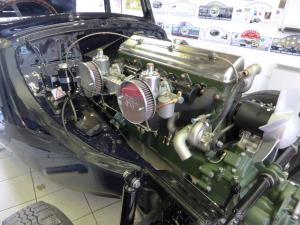
You will also notice from this picture the arrangement of the water pump; it is driven by the cam shaft and sits externally on the side of the engine. The new Davies Craig pump is of a similar size. I have used the existing mountings on the engine and with the new bracket I made it fits nicely on the side of the engine.


The Davies Craig System complete with the electronic controller is a “Plug and Play” system, it comes with it’s own wiring loom and just needs a few electrical connections, much like fitting a car radio.
With the new radiator fitted and the system filled with coolant I was ready to test it.

With an EWP® & Fan Digital Controller (12 & 24V) (PATENTS: USA 6425353, EU 1133624, AUS 756453), the speed of the pump is managed by the controller which varies the supply voltage to the pump and so varies the speed of the pump up or down hunting for a target temperature. When the engine reaches the target temperature, the controller locks on whilst constantly changing the Electric Water Pump speed to account for traffic and throttle conditions whilst all the while maintaining the target temperature independent of the engine speed. When the EWP® struggles to maintain your target temperature, the Digital Controller will operate the engine’s electric fan automatically once the engine has reached +3°C (+5.4°F) above the targeted / set temperature. Another significant benefit is that the Controller allows the EWP® & Fans to run on after ignition shutdown for either 3 minutes or -10°C (-14°F) of set / target temperature to eliminate heat soak.
Due to “lockdown” and the lack of an alternator my only testing has been confined to the workshop with the car stationary, so far the results are exactly what was claimed in the sales literature and what I was expecting. The ambient temperature in my workshop has been as high as 25 degrees during my tests.
To summarise:
1. The engine reaches its optimum operating temperature of 85 degrees very quickly.
2. That temperature is maintained without excessive use of the electric fan.
3. When the fan does run it is for a very short period of time as the pump is circulating the coolant more efficiently.
4. I have turned the engine off just as the electric fan starts and the fan and pump “run on” very quickly lowering the temperature. When the system shuts down close observation of the temperature gauge shows no signs of any “heat soak”
5. Finally, without the mechanical fan the engine is quieter and I am hoping to see a benefit in engine power and a reduction in fuel consumption.
All that remains now is for the alternator to be returned and fitted and a full road test undertaken, that will be for another day.
I have now had the car out on the two hottest days this year and it has behaved faultlessly.
I hope this helps Bob!
Best wishes Philippe
26th July 2020 at 5:17 pm #27094ParticipantHi Philippe’
Thank you for your very full reply to my enquiry. I’m massively intrigued by the electric pump/electric fan and ‘black box’ solution. Your instructions are very clear (lovely photos, lovely car!) as are those on the Davies Craig website. I think I could successfully make the installation. As I said in my original post I am going to approach the problem slowly and methodically being much encouraged by your and Bernie’s responses. In the meantime could you send me the part numbers of the equipment I would require – electric pump, fan and ‘black box’
Thank you again
Bob27th July 2020 at 7:42 am #27096ParticipantHi Bob,
Drop me an email and I will pass on all the info. My email is surrey-hants-sussex@traction-owners.co.uk
Philippe
18th August 2020 at 2:19 pm #27319ParticipantHi Bernie and Philippe,
Just to report progress re my Big Six.
Unless I’m missing something the problem is cured!!!! wow!
1 I made a new rubber washer for the radiator cap
2 Gave the cooling system the Thermocure Treatment
3 Fitted the locally-made air deflector as Franssens no 331.074
An immediate improvement. On a sweltering day with the air temperature in the high twenties, with the Thermocure in the cooling system, I gave the car a blast on the M5 between junctions 3 and 4.The highest I could get the coolant temperature was 85 degrees. That was uphill and nearly 70m.p.h! I then turned off the M’way into a queue of stop/start traffic. Briefly the temperature reached 90 degrees – no problem. Back on the M’way. Again 70m.p.h, again 85 degrees. Stopped at the Services to open the rad cap. Looks good – no bubbling of the coolant – light foaming of the Thermocure solution.
A few days later I flushed the system.
I’ve just been out for an hours drive. Country roads-can’t get the temperature above 70 degrees. Then the real test on the M5, maintaining near 70 m.p.h. the temp just touched 80 degrees. Off the M’way parked in a lay-by and let the engine idle for 3-4 minutes, temperature still not getting above 82 degrees. Ok,the weather was cooler than last week 21 degrees – typical English summer temperature.
Thank you for your advice. I take from these results that I will not need a new radiator core in the near future -that’s a relief!. I’m still very interested in the electric water pump and slim-line fan – this could be a project for the Autumn.
I’m very grateful for your interest and advice
Thank you
Regards
Bob19th August 2020 at 8:07 am #27322ParticipantBob,
Finally some good news re. 6 cooling.
I am curious to know what else came out of the system when you drained the Thermocure mixture. Was there a lot of muck?
As I said, having completely rebuilt my engine in 2017 (in parallel with Phil), I know my block and head are spotless inside so I do not need to consider that treatment. I also reconditioned the water pump and the reconned rad is now fitted. As both Mme. and I are “vulnerable” and this area has a particularly high incidence of the plague, I am still avoiding going out. So, as you will probably have seen elsewhere, I have taken this opportunity to do a lot of other jobs.
All finished now so I hope to fefit the wings today and then I may be tempted to take to the highways and byways for that long-awaited test run. I shall report, as requested, but I shall not be able to furnish such precise temperature detail as that you have supplied.
B…..
19th August 2020 at 2:33 pm #27328ParticipantHi Bernie,
It’s more useful if I go through the whole Thermocure treatment, so forgive me if I sometimes ” state the bl***ing obvious ” (to quote Fawlty Towers )1. Got 2 x 1 Litre bottles of Thermocure from Frosts Restoration. I had to get 2 litres as otherwise the concentration of the Thermocure/water would be slightly less than required. The total cost was approx £60 but as things turned out, was worth it.
2. Drained the radiator and engine block – then closed taps (obviously!)
3. Poured in One and a half litres of neat Thermocure. As the liquid went down I could hear a light -glug, glug- as though the air wasn’t able to be pushed out of some of the rad tubes because they were blocked at the bottom so the air had to be expelled from the top of the tubes(?). Topped up the system with water
4. Took the car out for a run on a very hot day. An immediate result! Water/Thermocure mix showing lower running temperature. Stopped to unclip the radiator cap several times. Looking good – foaming in the header tank but coolant liquid still there under the foam, no bubbling of the coolant.
5.Took the car out on several days – same result.
6. Decided to drain/flush the system when it was warm. All that came out was rusty liquid, no muck or flakes of debris. Flushed the system with a hosepipe in the header tank several times. I didn’t remove the bottom hose or take the radiator out, instead relying on the rad and engine block taps to drain the flushing water. So it is possible that there was muck in the bottom of the rad and engine block. I think that unlikely, as the flushing water flowed freely from both taps, with or without the hosepipe being turned on.
7. Filled the cooling system with water (antifreeze can wait until the autumn) and away we go!
That’s my experience. The solution to my overheating was so simple – I still think it a miracle!!! So, for the sake of £60 approx I recommend others with this problem to try Thermocure first. It may be my rad and block were not too bad, but then there was overheating – now cured- and the -glug, glug I heard did indicate some blocked tubes
Thank you for reading this far. This is my experience of this product. I went into this amount of detail as I want my experience to be as useful as possible to other Big Six/Traction Owners.
Feel free to contact me if I haven’t made anything clear.
Regards
Bob20th August 2020 at 9:11 am #27331ParticipantBob,
All very clear, thanks. I hope this will help others in the same position.
I was recently discussing the problem with Graham Kench and he raised the question how did/do those in “the colonies” manage? If 6s in Europe are overheating the problem must be far worse in places like South Africa and Australia but I am not aware of similar problems being reported from such places.
Does anybody out there know if the problem is as bad in those warmer climes? – and, if so, how do they cope?
B……
20th August 2020 at 9:16 am #27332David Faulkner
Participant7. Filled the cooling system with water (antifreeze can wait until the autumn) and away we go!
Bob ‘coolant’ contains anti corrosion additives and helps lubricate pump bushes etc. so you may want to review that decision sooner rather than later.
20th August 2020 at 6:07 pm #27333ParticipantThanks for the tip, David.
Regards
Bob
-
AuthorPosts
- You must be logged in to reply to this topic.