
ETHANOL SHIELD, FUEL STABILISER
Traction Owner’s Club › Forums › Technical › Engine › ETHANOL SHIELD, FUEL STABILISER
- This topic has 4 replies, 4 voices, and was last updated 7 years, 5 months ago by David Faulkner.
-
AuthorPosts
-
22nd October 2018 at 7:08 pm #23890
David Selfridge
Participant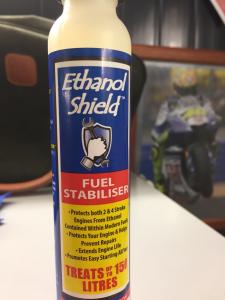 HI FORUM EXPERTS,
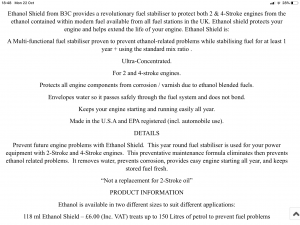
Has anyone any views, recommendations or advice on this product, would it be advisable for a Traction.
Would this additive eliminate the problems coming from the increased percentage of Ethanol in the modern petroleum. Would this help with the rubber hose and fuel pump diaphragm corrosion problems.
 U
U- This topic was modified 8 years ago by David Selfridge.
11th November 2018 at 9:54 pm #23992Chris
ParticipantHi Davy,
It looks like nobody knows – I had a quick google and couldn’t find any reviews on the stuff you are asking about.
I did find this though which is quite informative : – http://www.fuelsystemguide.com/what-is-the-best-ethanol-fuel-treatment/
The Lucas Oil product is available from Amazon and gets good reviews. Personally I have not suffered any problems from ethanol so far and not tried any of the fuel treatments.
Chris
3rd May 2019 at 8:54 am #24807David Faulkner
ParticipantLooks like I somehow managed to originally post this in the ‘Archive’ section so apologies for posting again.
I’m adding to this thread following recent issues with my Traction. Basically I had an exhaust valve on No3 cylinder burn out even though the head has hardened valve seats. The car has been run for around 12,000 miles on a mix of 95 ron unleaded and 98 Ron Premium unleaded and with a ‘Spitfire’ additive in the tank that others have used as well although I have not used an ‘Ethanol Stabiliser’ additive as all my fuel system has been replaced using ‘100% Ethanol safe’ items where possible having found that some flexible petrol pipining went ‘soft and spongy’ within a short period of time.
Reading back through floating power unleaded use has cropped up several times over the years and it is still relevant and it appears that professional advice was that using Premium grade fuel made no difference in a Traction. Now that advice came before Ethanol became a regular item in modern fuels though some sources claim that ‘Premium’ petrol has little or no Ethanol content, however is Ethanol in petrol as big a problem as no lead for running a Traction Avant?
Volume 14 1998 issue 01-2 June/July has an in depth article, part of which is worth repeating:
Fuel History: Before World War 2, leaded fuel was unknown. The maximum octane rating was about 92 but normal petrol had around 70. After the war, octane rating rose to 75 for normal petrol in 1956. At the end of the forties, lead was added.
Traction engine development: The first 70/s had a compression ratio of 5. 7:1. Later, with the increase of piston displacement, the compression ratio also rose to 5.9:1 and then to 6.2: 1. The first 11 OJ shad a compression ratio of 5.9: 1, increasing to 6.2:1 with the introduction of the ‘Perfo’ engines. From 1950 until May 1955 it was at 6.5: 1. The 11 D engine had, from 1955 to the end of production, a compression ratio of 6.8: 1. The 15/6 had a ratio of 6.2: 1 until 1949, and later 6.5:1 until the end of production.
Lead additives in petrol not only avoid ‘knocking’ but also decreases the valve seat wear. In addition, the lead helps to improve heat transfer. In the case of leaded petrol, the closing valves ‘beat’ onto a relatively soft, damping layer which is not built-up with un-leaded fuel.
The valve clearances thus decrease more rapidly, and burnt valves can be the consequence of neglecting regularly to check the valve clearances. Until the end of the forties, petrol was unleaded and cylinder head reconditioning was practised every 20,000 to 50,000 km and was considered to be a regular repair.
Volume 14 1998 issue 3 July has an item from FBHVC has a further item basically confirming the 1st article but leaning towards ‘additives’ available only being partially effective
Finally Volume 15 1999 issue 2 May has a further article that concludes that cast iron engines were more at risk from unleaded fuel and that whilst wear rates were unpredictable and could vary widely in a 4 cylinder configuration No 3 cylinder frequently displayed the highest rate of exhaust valve seat recession which mirrors my personal experience.
The above are selected parts of the articles listed and it is worth reading them fully.
I’m personally guilty of not checking valve clearances since the engine rebuild in 2013 which has proved an expensive error and wish I had read those articles earlier, so will now make valve clearance checks part of my annual routine maintenance.
3rd May 2019 at 11:55 am #24814Philippe Allison
ParticipantMy experience for what it’s worth, I finished the rebuild of my Light 15 Roadster in 2012 and since then have done over 20,000 miles of hard fast driving all over Europe, we have also crossed the Pyrenees into Spain over the infamous Col de Tourmalet. So far all is good and at this years annual check over (last week) compression’s have not decreased and nor has cylinder leakage. Valve clearances had changed slightly on a couple of valves but most were OK.
I have consciously used Super Unleaded as this has the lowest or in some cases no ethanol added. (please check oil companies web sites for the latest information), I also use Classic Valvemaster Plus which is a lead replacement and octane booster. (The head has been skimmed and dome topped pistons fitted).
I will of course have no idea if what I am doing is right until I have a failure and strip the engine, but so far so good.
Good luck with you choice of products.
Philippe Allison
4th May 2019 at 9:46 am #24824ParticipantThanks for the feedback Phil, it’s good to hear from someone who uses their Traction regularly over long distances.
BTW saw the roadster at Magny Cour last year and it’s still looking good but missed you as we were only visiting on our way to Italy sans Traction.
-
AuthorPosts
- You must be logged in to reply to this topic.