
Electric Fuel Pump
Traction Owner’s Club › Forums › Technical › Other › Electric Fuel Pump
- This topic has 6 replies, 2 voices, and was last updated 3 months, 2 weeks ago by Robert Filbey.
-
AuthorPosts
-
30th May 2026 at 7:08 pm #38289
Robert Filbey
ParticipantI have a French built traction, 1953 11BL, which is on a 6 volt system. It has an electric fuel pump however I can’t vouch for it’s quality (I didn’t install it). Anyway I was wondering if anyone had a recommendation for a quality 6 volt fuel pump. I’m in the US so it would be great if I could source it here but I know that’s not always possible. Thanks very much!
Kirk Filbey
31st May 2026 at 1:37 pm #38297Bernie
ParticipantKirk,
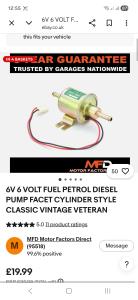
I have used pumps like the one in this ad on several Tractions.
I bought the last one about 10 years ago and my online search back then found a number of similar pumps readily available on the US.
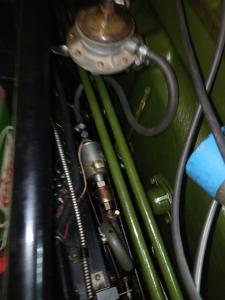
It is fitted to my 15/6 and, although it is perfectly capable of running the car on it’s own, I generally only use it to prime the system when it has been stood for more than just a couple of days. It also proved invaluable when we experienced vapour lock in very hot conditions on the way to the Polish ICCCR.
I have it fitted in series with, and just before, the mechanical pump. Power is taken from the ignition switch via an overide switch on the dash.
B…..
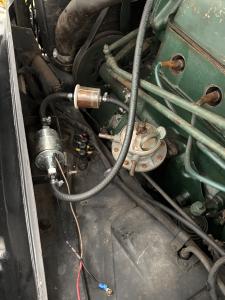
2nd June 2026 at 2:43 am #38317ParticipantBernie, thanks very much for this information. On my car the mechanical pump is not used at all. The fuel line goes into a fuel filter and then into the pump. The line then exits the pump straight to the carb. On a drive recently the car suddenly lost power and stopped as if it was starved of fuel. I couldn’t get the car started (luckily it wasn’t too long of a push back to the house). A few days later I disconnected the hose from the carb, fired up the pump to make sure it was pushing fuel, then connected line back….and the car started up. Very strange…perhaps an air bubble in the line? Not sure. Do you happen to know at what PSI the pump should be operating?
 2nd June 2026 at 2:36 pm #38319Participant
<p style=”text-align: left;”><span style=”font-family: ‘Google Sans’, Roboto, sans-serif; font-size: 18.4px; margin: 0px; border-bottom: 0px #0a0a0a;” data-subtree=”aimfl,mfl” data-copy-service-computed-style=”font-family: "Google Sans", Roboto, sans-serif; font-size: 18.4px; font-weight: 400; margin: 0px; text-decoration: none; border-bottom: 0px rgb(10, 10, 10);”>The recommended fuel pressure for the Solex 32 PBIC carb is between 1.5 and 3.0 psi (0.10 to 0.2 bar)</span>.</p>
<span style=”font-family: ‘Google Sans’, Roboto, sans-serif; font-size: 18.4px; margin: 0px; border-bottom: 0px #0a0a0a;” data-subtree=”aimfl,mfl” data-copy-service-computed-style=”font-family: "Google Sans", Roboto, sans-serif; font-size: 18.4px; font-weight: 400; margin: 0px; text-decoration: none; border-bottom: 0px rgb(10, 10, 10);”>For Solex 35 FAI carbs, the recommended fuel pressure is 1.5 to 3.5 psi,</span> with 2.5 psi being the ideal sweet spot.
<p style=”text-align: left;”>Keeping the fuel pressure within these ranges is critical, as anything higher will easily overpower the needle valve, flooding the float bowl and causing the engine to run rich.</p>
B…..2nd June 2026 at 2:42 pm #38321ParticipantTry again ….
<p class=”MsoNormal”><span style=”font-size: 9.0pt; line-height: 115%; font-family: ‘Source Serif Pro’,serif; mso-fareast-font-family: ‘Times New Roman’; color: black; background: #FBFBFB;”>The recommended fuel pressure for the Solex 32 PBIC carb is between 1.5 and 3.0 psi (0.10 to 0.2 bar)</span></p>
<p class=”MsoNormal”><span style=”font-size: 9.0pt; line-height: 115%; font-family: ‘Source Serif Pro’,serif; mso-fareast-font-family: ‘Times New Roman’; color: black; background: #FBFBFB;”>For Solex 35 FAI carbs, the recommended fuel pressure is 1.5 to 3.5 psi, with 2.5 psi being the ideal sweet spot.</span><span style=”font-size: 9.0pt; line-height: 115%; font-family: ‘Source Serif Pro’,serif; mso-fareast-font-family: ‘Times New Roman’; color: black;”><br style=”mso-special-character: line-break; font-variant-ligatures: normal; font-variant-caps: normal; orphans: 2; widows: 2; -webkit-text-stroke-width: 0px; text-decoration-thickness: initial; text-decoration-style: initial; text-decoration-color: initial; word-spacing: 0px;” /><!–[endif]–></span></p>
<!–StartFragment–> <!–EndFragment–>
<p class=”MsoNormal”><span style=”font-size: 9.0pt; line-height: 115%; font-family: ‘Source Serif Pro’,serif; mso-fareast-font-family: ‘Times New Roman’; color: black; background: #FBFBFB;”>Keeping the fuel pressure within these ranges is critical, as anything higher will easily overpower the needle valve, flooding the float bowl and causing the engine to run rich.</span></p>2nd June 2026 at 2:48 pm #38323ParticipantBummox! Having tried twice to give more detail, in a nutshell, the above should say …
32PBIC requires 1.5 to 3.0 psi
35FAI requires 1.5 to 3.5 psi.
Exceeding these figures is likely to override the needle valve and cause the engine to run rich.
B…
2nd June 2026 at 8:03 pm #38325ParticipantOh now that’s interesting. I wonder if that’s what’s been going on with my car. I have a 32PBIC. Seems to be hard to find a pump that pumps that low, guess I would need to find some sort of regulator. Again, thanks for this information.
Kirk
-
AuthorPosts
- You must be logged in to reply to this topic.